Tuesday, July 14, 2009

NECC - Day 1

I missed the Sunday Keynote of Malcom Gladwell, so my first real day at NECC was on Monday. Since I was staying for friends I navigated the metro in from Maryland to the convention center. I was extremely grateful that NECC not only has an online planner, but that I can subscribe to the feed on my iCal & iPhone. I didn't have to carry my program around, I could just look at the calendar on my phone & see where to go. The only drawback is that it doesn't designate who the presenter was - so it was hard to decern where I wanted to go.

My first day was mostly tied up with meeting with the University of Texas at Austin about their College of Education 1:1 laptop program & meeting with my fellow presenters for our Ning presentation the following day. I atteneded about 30 minutes of an Ian Jukes session - but he said "Digital Natives" just too many times for my taste. I missed Scott McLeod's session, that everyone raved about, but luckily it was recorded on http://www.istevision.org/


The best part of the day was getting a chance to meet Lee & Sachi Lefever of Common Craft and talk about their creative process as well as how their videos are used in schools. I also discovered that Lee grew up a few miles from me in Kernersville, NC before moving to Seattle, WA - whereas I was born in Seattle & moved to Winston-Salem. It was great to talk to them about their travels and their process and I hope they enjoyed their first education conference!

EBC - Can we change education?

One of the reasons I love EBC is getting to meet with the people I follow and talk to on Twitter. Jon Becker is one of the those people I was looking forward to seeing and talking to face-to-face. His Edubloggercon session reminded me of what I wish every graduate course had been like. An informed and honest discussion about the state of education. Specifically his session was titled, "Where School Reform Meets Madonna: Can public schools fundamentally reinvent themselves? (Jon Becker & All the Cool People) [NOTE: anyone who mentions a tech. tool has to stand on a table and sing "Loving Feeling"]"

Because even though technology is what this conference "is all about" - really it is about changing our schools. We had an honest and frank discussion about the changes we wanted to see in education and the reality that it may not come to pass. What interested me is all these pockets of innovation that never really seem to be accepted into mainstream education. That innovation is not a new idea and so many of these ideas about changing the status quo have been around. So why not? Can change come from the inside? Does there need to be an outside event? Do we need another Sputnik? And if so - does that leave educators with our hands tied behind our backs? It was almost a bit disheartening, but then you realize that all the people in this discussion are "Fighting the good Fight," and I like to think we are making a difference, but can we make systemic change - I'm not sure .

Oh and Kristen Hokanson mentioned a tech tool - but didn't have to sing :)

Tuesday, July 7, 2009

EBC - Professional development

I started out with a discussion on Professional Development which Liz Davis started (and Alice Mercer covered in her blog). We had a great discussion (and commiseration) about how difficult getting teachers to come to PD is, and ways that we can change our strategy for PD. Jeff Utech shared how he puts his teachers on an individualized "tech plan." Although I love this idea, I doubt my professors would be up for it. But I do like the idea of customizing goals with our instructors, and meeting with them one-on-one to tailor tech integration to their needs.

We also had a great discussion about different ways of offering PD, from Open Lab sessions, to planning time, etc. Most of us have found that doing a teaser (such as the Wired Wed I conduct) work as effect teasers, as well as give us an idea of interest before having a full blown workshop. I struggle with the idea of consistency (something every week or every other week) vs. only holding them based on interest. Last semester I didn't host any workshops, only Wired Wed. I'll try to do a bit of both this year, but definitely focus on more one-on-one interactions.

The only down side is that I missed the Web 2.0 smackdown AGAIN! Luckily you can get all the great Web 2.0 tools & UStream Video on http://coolcatteacher.wikispaces.com/Web+2+Smackdown

Edubloggercon 2009


This year Steve Hargadon once again outdid himself as our "ambassador" to ISTE and arranged for Edubloggercon. Edubloggercon, which I agree with Steve has less to do with blogging, and more to do with subversive teaching, is a chance for educators to get together and share ideas about what technology integration really looks like. For me it is also a chance to connect with those that I converse with online. Face-to-face is still important to me. I get a good deal of info online, and enjoy making friends on Twitter, but I still want to just hangout sometimes :)

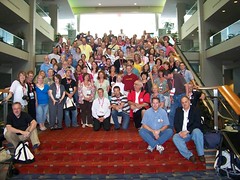
Edubloggercon is set-up as an unconference, I like to think of it as controlled chaos. Pick a topic any topic, see if people show up to talk about it, you get an hour and then do it all over again. I made it to about 3 sessions before my brain went into overload, and I needed a mental break - but I did make it into the picture this year :)

NECC & Edubloggercon

NECC & the pre-cursor Edublogercon have become one of my favorite events of the year. I get a chance to connect Face to Face with all of the people I tweet or Ustream or blog with. It gives me a chance to be inspired about the possibilities of education again and how true technology integration can occur. This year however, I found myself Tweeting much more Blogging and I find myself almost an entire week later without a single blog post. I'd like to say I've spent that time "reflecting," but really it has been more about recovering!

Hopefully the following blogposts will highlight some of the best reasons why so many of us go to NECC every year, most of us on our own dime.


Created with flickr slideshow.

Tuesday, June 23, 2009

Ninging @ NECC


This year will mark my first time presenting a NECC, and I couldn't be more excited or more nervous. I decided to present on what we were doing at the College of Education with Ning, but I thought that some of the other "people behind the Ning" would be interested so I put out a call on Twitter. Boy did I get an incredible & wonderful set of responses. I am honored to co-present with the following:

Dean Mantz was Director of Technology for USD 405 in Lyons, Kansas. Dean has recently taken a position with USD 376 in Sterling, KS. He conducts technology integration trainings with teachers from a variety of fields to help create interesting lessons to education-impacting problems. Prior to his current position, he served as the Assistant Director of Technology and was the lead instructor for the Rice County Technology Academy.

Dianne Krause is the Instructional Technology Specialist and Classrooms for the Future Coach at Wissahickon School District in Ambler, PA. She
works with teachers district-wide to best integrate technology into their teaching and to develop 21st century skills in students. Prior to this position, Dianne was a French teacher recognized as a Keystone Technology Integrator for her technology integration into her courses.

Amira Fouad, Program Manager for RezEd.org, the Hub for Learning and Virtual Worlds, a network launched by Global Kids Inc. in March of 2008. Amira worked as a facilitator for the Project Tolerance Fellowship and the National Coalition Building Institute in programs utilizing conflict mitigation and informal education as a vehicle for peace building and community development.

Sheryl Grant is the Director of Social Networking for HASTAC/MacArthur Digital Media & Learning. She is a former instructor for UNC-ITS Teaching & Learning, and coordinator for the Community Workshop Series, an award-winning program serving free information literacy workshops to the general public.

We will be discussing the following Nings & how we adminsiter them:

The College of Education at NC State is utilizing Ning to leverage the the popularity of these SNS, such as MySpace and Facebook, in a more professional environment with their pre-service teachers. Their goal is to encourage discourse and sharing both in and out of the classroom. Students are grouped not just by class or course in the Ning network, but by interest and social groups.

The HASTAC/MacArthur Digital Media & Learning Winners' Hub uses Ning in order to create a public learning experience. Winners report to the hub as their projects evolve and create a "learning legacy" that serves successive winners and others in the digital media and learning community.

RezEd is a Ning- supported community of practice that brings attention to the myriad ways virtual worlds are being used for learning in various settings. It covers both commercial and educational virtual worlds through news updates; multimedia resources; a podcast series with youth, theorists, world builders, practitioners and experts in the field; a curated best practice report series, various digital media resources, guest-moderated discussions, etc. In addition, knowledge is generated and shared as members contribute photos and videos, facilitate special interest groups, and manage personal blogs.

The Wissahickon School District uses Ning as a professional learning network for faculty and staff of the district. The Ning network is for sharing, collaboration, support and communication district-wide. Groups are created for each grade level, school, department and other special-interest audiences. Resources are shared amongst colleagues in different buildings and grade-levels. Wissahickon is also exploring the use of Nings with students and its implications on pedagogy and learning.

The Future Kansas Teachers Scouting Ning was designed by ESSDACK to allow talented future teachers to be discovered and recruited by great districts.

Join us if you can in the Open Source Lab!

Tuesday, 6/30/2009, 12:30pm–1:30pm WWCC 152 B

When to Skype & when to Elluminate


I run into this problem a good deal in my job. A new tool comes out and everyone wants to use it - whether it is better or not. Now I understand this, I love playing and tinkering with new toys, but when I teach others, I more often go for stability than cool. The Newness of a tool wears off too fast for me. My first question when someone wants to try out a tool is not "Why?", but "What are you trying to use the tool for?" This gets at the heart of what a teacher is trying to accomplish by using a tool, and can allow me as a technology facilitator to help them find the most appropriate fit.

So the question comes across my desk about using Skype or Tokbox instead of Elluminate. We are lucky to have a university wide liscence of Elluminate & I am a big fan of the product. I've taught and been taught via Elluminate for the past couple of years and am familiar with it. Now I've never been very successful with the video on Elluminate and have mostly relied on the audio interaction. The whiteboard tool is excellent (especially when you upload presentations) and the polling feature is essential in a Distance Ed class. Application sharing can be a bit tricky, but an important tool. Overall the group interactions have been quite good.

The request to use Skype came as a suprise to me & I wanted to know more about why the change. And what it came down to was that these teachers missed the face to face and wanted more of that kind of interaction. The school based teams meet together in the computer labs and all get on Elluminate next to each other. Now I think of Elluminate as a great tool, because you can do it from anywhere, home, work, school, or Starbucks and because of the interaction tools for large numbers of people. But this was a different senario.

My typical recommendation would be that Skype is for one to one conversations and that Elluminate is for large group interactions, but now we had a combination of both. So guess what they wanted to do? Now we will be using Elluminate to facilitate the text chat, application sharing, & presentations, but utilize the video & audio frm Skype on the big screen in the 2 schools.

I'm interested to see how this works, becuase sometimes the best tool is a combination of them...